Pre-Mortem Analysis
Overview
Pre-Mortem Analysis is a decision-making technique that involves imagining that a decision or project has already failed, and then working backward to identify possible causes of that failure.
Unlike traditional risk analysis, which focuses on predicting success probabilities, Pre-Mortem explicitly assumes failure has occurred. This shift reduces overconfidence, surfaces hidden risks, and helps teams identify vulnerabilities that are often ignored during planning.
It is widely used in strategic planning, project management, and high-stakes decision environments where uncertainty and complexity are high.
Origin
The Pre-Mortem technique was introduced by psychologist Gary Klein in the early 2000s as part of research in naturalistic decision-making.
It was developed as a response to the limitations of traditional “post-mortem” analysis, which only examines failures after they occur.
Klein observed that teams often suffer from overconfidence bias during planning, leading to underestimated risks and overlooked failure modes. Pre-Mortem was designed to counteract this by normalizing dissent and structured pessimism before execution begins.
Evolution
Over time, Pre-Mortem Analysis has been adapted across multiple domains:
Project Management: Used to identify execution risks before launch.
Product Development: Helps teams anticipate user adoption failures.
Strategy & Leadership: Used to stress-test organizational decisions.
Startups & Venture Planning: Used to surface hidden market and execution risks early.
Modern adaptations include digital facilitation tools, AI-assisted risk generation, and integration into agile sprint planning cycles.
Despite its evolution, the core principle remains unchanged: assume failure first, then understand why.
Significant Use Cases
Strategic business planning
Product launch evaluation
Investment and funding decisions
Policy and governance planning
Team and organisational decision-making
Use Case Categories
Business Strategy
Product & Technology
Finance & Investment
Operations & Execution
Leadership & Teams
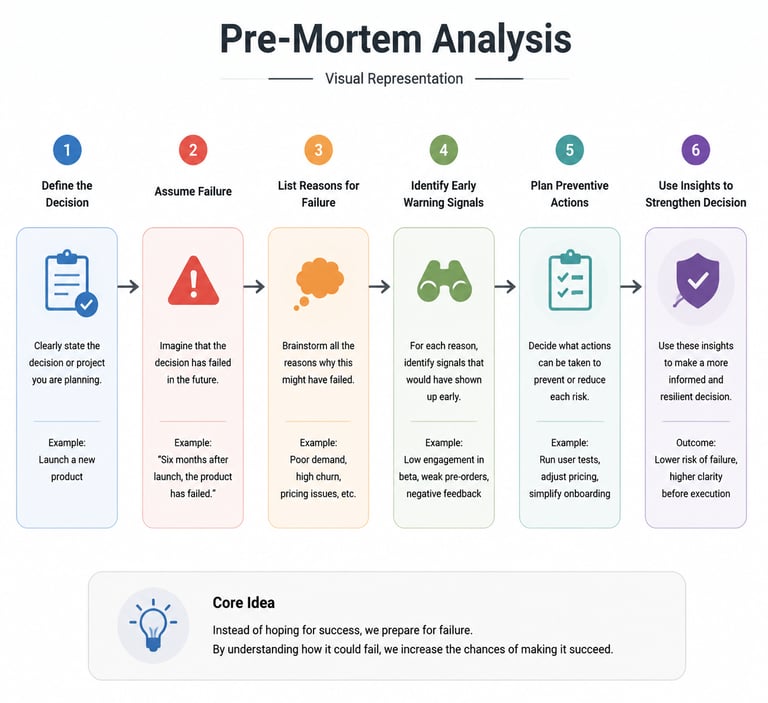
Sample Use Cases and Step-by-Step Guide
Scenario: A startup is preparing to launch a new product.
Step 1: Define the Decision
“We are launching a new product in 60 days.”
Step 2: Assume Failure
The team begins with the assumption:
“Six months after launch, this product has failed.”
Step 3: Generate Failure Reasons
Participants independently list reasons for failure:
Market demand was overestimated
User onboarding was too complex
Competitors released a better alternative
Pricing was misaligned
Internal execution delays occurred
Step 4: Group and Analyze Risks
Cluster identified reasons into categories:
Market risk
Product risk
Execution risk
Adoption risk
Step 5: Convert into Preventive Actions
Each risk is translated into mitigation steps:
Validate demand through pre-launch testing
Simplify onboarding flow
Monitor competitor movements
Adjust pricing strategy early
Decision Design Lab Interpretation
At Decision Design Lab, Pre-Mortem Analysis is seen as a structured method to reduce overconfidence in decision-making systems.
We interpret it not just as a risk identification tool, but as a cognitive reset mechanism — it forces decision-makers to temporarily invert optimism bias and surface hidden assumptions.
In SelfSignal terms, Pre-Mortem functions as a “failure-simulation lens” that strengthens decision clarity before commitment.
Scholarly Links
Gary Klein – “Performing a Project Pre-Mortem” (Harvard Business Review, 2007)
Kahneman, D. – work on overconfidence bias and planning fallacy
Tversky & Kahneman – Prospect Theory foundations
“The Planning Fallacy” – Kahneman & Lovallo research
Essential Reads & Interpretations
Daniel Kahneman – Thinking, Fast and Slow
Gary Klein – Sources of Power
Bent Flyvbjerg – How Big Things Get Done (reference on planning fallacy)
Authors
Gary Klein: Originator of Pre-Mortem technique
Daniel Kahneman: Research on cognitive bias and overconfidence
Amos Tversky: Foundational work in behavioral decision theory
Author/Framework Website
Harvard Business Review: Pre-Mortem Method
Video Links
Using PreMortem Analysis to Make Better Decisions with Gary A. Klein- YouTube
Visual Representation
© 2026 Decision Design Lab
An Opteria Y Private Limited Initiative